
From SWOT to TOWS: turn findings into actions to test
Turn SWOT evidence into TOWS action candidates, then plan a small test with a six-person-day limit and clear stopping conditions.
On this page
A completed SWOT can leave a team with a useful table and no clear idea of what to do next week. A TOWS matrix takes the analysis further: pair internal conditions with external opportunities or threats, propose specific actions, and check the assumptions those actions depend on.
Start when the four SWOT sections contain reasonably specific evidence. If your strength is only “a professional team” and your opportunity is “a large market,” gathering evidence is more useful than generating more combinations.
Use one goal to select relevant conditions
Fictional example: a two-person team provides a workshop registration tool. Over the next two weeks, it wants to test whether serving more small training providers is worth pursuing. The team has 10 person-days available, of which 4 are committed to supporting current customers. New experiments can use no more than 6 person-days.
| ID | Condition | Evidence and limits in this example |
|---|---|---|
| S1 — strength | Existing users can repeat the core workflow | Of 8 trial organizations, 6 used it twice within four weeks. The sample is small. |
| S2 — strength | Standard setups are relatively quick | Of 8 setups, 7 were completed within one week. This applies only to standard setups. |
| W1 — weakness | Limited capacity for complex integration | The tool has not been connected to customers' finance systems. |
| W2 — weakness | Limited capacity for new work | Only 6 person-days remain for testing over the two weeks. |
| O1 — possible opportunity | Similar organizations have asked about related needs | In 12 interviews, 5 organizations asked about a paid pilot. None of these inquiries is an order. |
| T1 — threat | Standard alternatives exist | In this fictional case, a competitor already offers basic registration features. Its pricing and customers' willingness to switch remain unverified. |
Classify internal and external conditions relative to the team you are analyzing. The team can change its integration capability, so that belongs under weaknesses. It cannot decide whether customers want to buy, so the interviews provide a possible external opportunity that still needs testing.
Turn combinations into specific actions
Ask how a strength might help you pursue an opportunity, how an opportunity might help you address a weakness, how a strength might help you respond to a threat, and where weaknesses and threats together justify limiting your effort.
| Combination | Candidate action | Key assumption |
|---|---|---|
| S1 + O1 | Show the repeat-use workflow to interviewees with a clear need and invite them to a limited pilot. | They will commit to actual use, rather than just express interest. |
| W1 + O1 | Test the finance handoff using exported files and a manual process first. | Customers can accept this temporary arrangement. Do not describe it as a completed integration. |
| S2 + T1 | Explain the standard setup process and test whether customers value the ease of deployment. | This difference matters enough to influence their choice. |
| W2 + T1 | Exclude opportunities that need complex integration for now and cap this round's effort. | The team accepts passing up some opportunities in the short term. |
These are candidate strategies. Filling all four cells does not mean you should carry out all four. Different combinations may produce similar actions that can be merged. Leave a combination empty if it does not suggest a meaningful action.
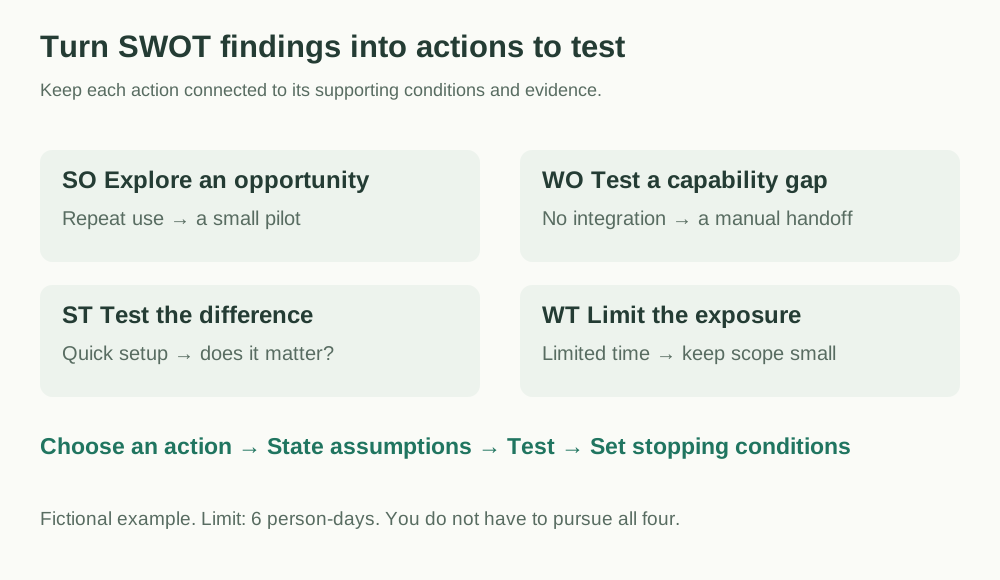
Make one candidate small enough to test
The team could begin with a narrowly scoped pilot. Contact the 5 organizations that asked about a paid pilot. Check who has an upcoming event, who can make the decision, and whether complex integration is required. Continue the pilot discussion only when the needs and conditions fit.
Allow 1 person-day for qualification and requirements, up to 3 for one standard setup pilot, 1 to observe use, and 1 in reserve for problems. The total stays within 6 person-days. This allocation belongs to the example; it is not a standard project estimate.
Set stopping conditions before starting. If no organization commits to using the tool for a specific event, return to investigating needs. If finance integration is required before anyone will try it, estimate the work again. Do not quietly expand the scope within the existing budget.
There is a gap between “customers asked about a paid pilot” and “customers will buy.” TOWS helps you propose an action. A test helps you assess whether that action is worth pursuing.
Keep each action connected to its evidence
Organize the conditions with SWOT analysis, then use the combinations above to explore actions. The TOWS matrix guide provides an editable example. Attach the relevant condition IDs to each candidate so you can trace its reasoning later.
Candidate action: What will you do?
Supporting conditions: Which strengths, weaknesses, opportunities, or threats support it?
Key assumption: What has not yet been confirmed?
Test: How will you get the evidence needed to decide?
Effort and stopping conditions: What is the resource limit, and when should you change course?
If an input changes—for example, customers no longer need a short pilot—the condition IDs help you find the affected actions. That makes revision easier than keeping only a statement such as “expand marketing.”
Practice data: SWOT evidence, capacity, and stopping conditions.