
What Nespresso illustrates about business model dependencies
Use a historical Nespresso example to connect business model blocks while keeping sourced facts, assumptions, and unknowns separate.
On this page
A business model canvas is more useful when you examine the connections between its nine blocks. What must happen for the proposed value to generate revenue? Which activities, channels, and costs make that possible?
Nespresso provides a historical example of those connections. It also shows why a familiar brand name is not enough evidence to fill every block.
Establish what the sources actually describe
Scope: this article uses two Strategyzer teaching articles published in 2015. It does not describe Nespresso's complete current business model or claim access to its internal decisions.
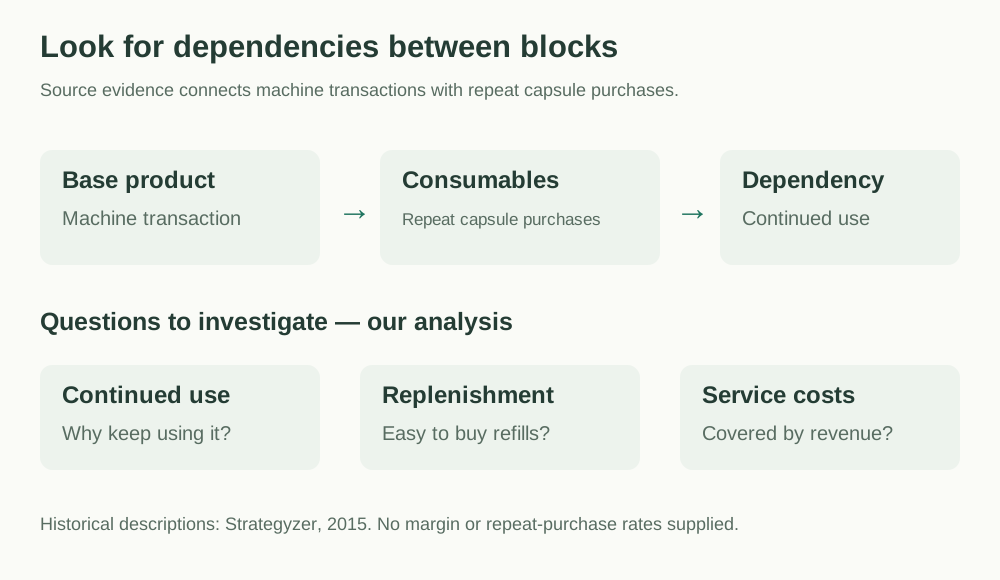
In How to prototype radically different business models, Nabila Amarsy describes coffee machines as base products and capsules as consumables, connecting machine transactions with repeated consumable purchases. Her article 12 mistakes to avoid when turning an idea into a business also mentions direct capsule sales. Both were published in 2015.
These descriptions support a relationship between the initial product, continued use, and subsequent purchases. They do not provide customer segment shares, margins, repeat purchase rates, acquisition costs, supply contracts, or the current channel mix. Do not fill those gaps with plausible-looking numbers.
Map the evidence and keep the gaps visible
The table separates source descriptions from our analysis and questions. An empty or uncertain block is useful when it identifies the next evidence you need.
| Canvas block | What this example lets us say | Evidence status |
|---|---|---|
| Value propositions | The historical description links machines and capsules. | Source description; not a complete account of customer value. |
| Revenue streams | Machine transactions connect to repeat capsule purchases. | Source description; no margin or purchase-rate data. |
| Channels | One source mentions direct capsule sales. | Source description; not a full or current channel inventory. |
| Customer relationships | Repeat purchasing raises questions about ongoing contact and service. | Our analysis; the specific mechanisms need evidence. |
| Customer segments | Different customers may have different needs and economics. | Unknown here; do not assume one uniform segment. |
| Key activities | Check how delivery, replenishment, and service are coordinated. | Our proposed investigation. |
| Key resources | Product design, supply, and customer contact may require distinct capabilities. | Questions to verify; the sources do not establish the full resource base. |
| Key partners | Responsibilities and bargaining relationships need investigation. | Insufficient evidence in these sources. |
| Cost structure | Costs would be needed to assess margin or payback. | Unknown; repeat purchases alone do not establish profitability. |
Use the Business Model Canvas guide to review the nine blocks and try an editable example. For this exercise, the aim is to connect claims to evidence, rather than make the canvas look complete.
Test the connections between blocks
The following questions are our analysis of the pattern, not findings about why Nespresso succeeded:
- Continued use: What gives a customer a reason to keep using the initial product?
- Replenishment: Can the customer obtain the consumable easily when needed?
- Economics: Can the resulting revenue cover the resources and service required?
These questions connect value propositions and customer behavior to channels, activities, revenue, and costs. If replenishment is inconvenient, a recurring-purchase assumption may fail even when customers like the product. If service is expensive, repeat sales may still leave unattractive economics. Both statements describe possibilities to investigate, not measured outcomes in this case.
Transfer the questions to a different product
Fictional exercise: a team is considering an indoor gardening kit. It could sell the kit alone or offer optional seed and growing-substrate refill packs as well.
The team should not borrow coffee consumption frequency as a forecast for gardening refills. Invite people with gardening experience to discuss and, where possible, demonstrate how they use a kit. Observe when supplies run out, what prompts replacement, and what alternatives they choose. Expressions of interest are not evidence of a purchase decision.
Record a specific assumption, the evidence needed to assess it, and the next check. For example: “People who continue using the kit will need refills that they prefer to buy from us.” That statement contains at least three questions: continued use, replenishment timing, and supplier choice. Investigate them separately before estimating recurring revenue.
Practice material: Historical evidence, unknowns, and the gardening exercise. Keep sourced facts, your interpretation, and the fictional transfer exercise distinct as you revise the canvas.