
A GROW coaching conversation from open questions to follow-up
Compare open questions, leading responses and necessary instruction, then inspect chosen actions, manager suggestions and support in a complete conversation.
On this page
A useful coaching conversation leaves the person with a next step they chose after exploring the situation, and a record that makes follow-up possible. Listen before offering solutions. Filling four boxes with a manager's answer does not make a conversation good coaching.
This original fictional exercise moves from a conversation to a written record and its first follow-up. The inline dialogue practice compares possible next responses, then helps you inspect who suggested an action, who chose it, and whether support was actually agreed. You can also download the dialogue, blank worksheet and shared facts for your situation.
Check whether coaching fits the problem
Fictional exercise: Lan wants to organize customer demonstrations more confidently within four weeks. In a ten-minute practice, she asks one opening question about customer needs, then mostly explains features. She and her manager can review the recording. No customer-satisfaction, sales or capability-assessment data are available.
If the person does not know how a product works, provide the necessary instruction. If a mandatory safety requirement applies, explain the requirement and authority first. Coaching can explore a challenge with room for choice; it does not replace instruction, a formal decision or urgent action.
The GROW model organizes a conversation around Goal, Reality, Options and Will / Way forward. You can return to an earlier part as information changes. Performance Consultants' explanation also emphasizes open questions, exploring options and the person's choice of action. Adapt the questions to the conversation rather than following a fixed list.
Let the person describe the goal
| Conversation | What to record | Distinction to retain |
|---|---|---|
| Manager: What would you most like to change in your next demonstration? | An open exploration, without a prescribed answer | Different from telling Lan to ask more questions |
| Lan: I want to hear what the customer needs before I start explaining features. | The person's goal direction | A way to check progress is still needed |
| Manager: What would you look for in a recording? | An observable sign of progress | Different from customer satisfaction |
| Lan: In four weeks, I want to ask two opening questions and adapt the order to the answers. | A questioning and adaptation goal | Question count alone does not establish relevance |
Two questions make part of the practice observable. They do not prove that Lan understands a customer. Ask what the answers reveal, and what she would do if they did not change the demonstration.
Separate observations, explanations and resources
| Record | Material in this exercise |
|---|---|
| Observation | One opening needs question in the ten-minute practice; feature explanation follows |
| Lan's explanation | She worries about running out of time and wants to cover all features; this is her explanation, not a diagnosis |
| Resources | A practice recording, room for two personal rehearsals, and the option to request colleague feedback |
| Unconfirmed | The colleague's availability, relevance to real customers, and actual customer impact |
“She does not care about customer needs” infers a motive. “The recording contains one needs question” retains an observation you can check. Resources also have a status: being able to request help is different from having agreed support.
When Lan worries about running out of time, return to a specific moment and ask what led her to continue explaining features, then explore alternatives. “You agree you should practice my script, right?” already contains the manager's answer. If a manager needs to offer a suggestion or state a work requirement, name it explicitly and clarify understanding and available choices.
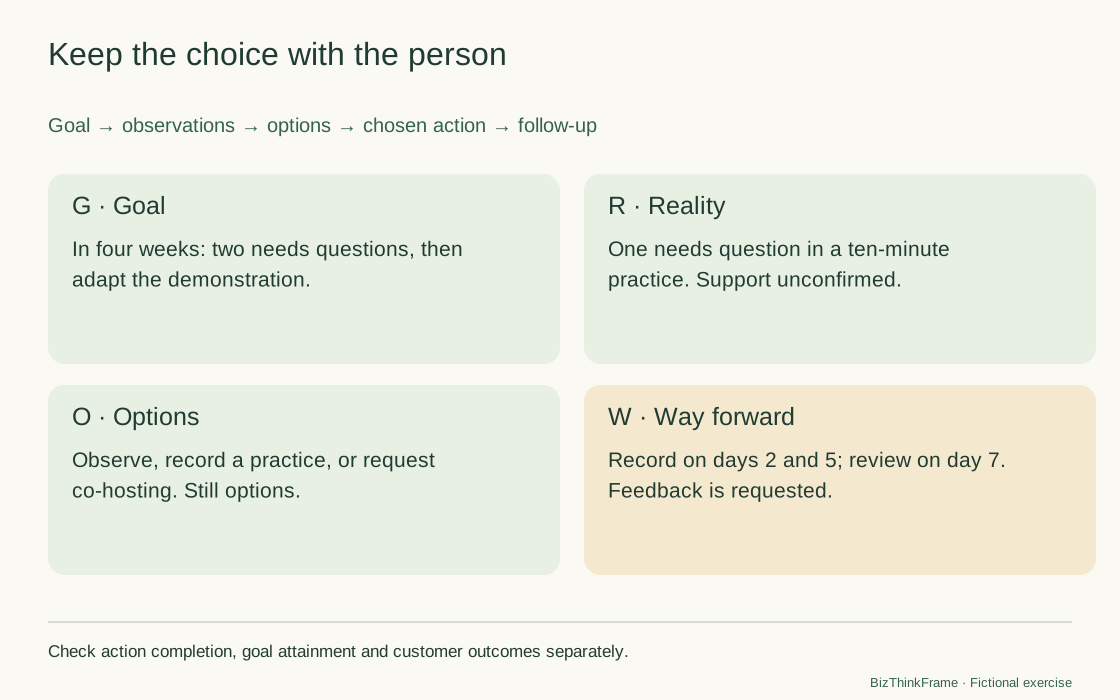
Keep options open until the person chooses
Lan suggests observing a colleague, recording two practices, or requesting co-hosting for a real demonstration. The manager asks what support each requires and which Lan can start this week.
Lan chooses a ten-minute recording on exercise day 2 and day 5, and requests one feedback session from a colleague. The recordings are her confirmed actions. Feedback still awaits the colleague's response. Exercise days are relative teaching times; replace them with actual dates and times when adapting the record.
| Field | Record at the end of the conversation |
|---|---|
| Chosen action | Record twice, practicing opening questions and changing the order |
| Timing | Exercise days 2 and 5; review on day 7 |
| Inspectable output | Two recordings and self-review notes |
| Dependency | Whether and when the colleague can offer feedback remains unconfirmed |
| Follow-up | Inspect questions, answers and changes to the demonstration; discuss what to practice next |
A weak record says, “The manager assigned co-hosting, the colleague will give feedback, and the goal will be met in four weeks.” It turns an option into an instruction, a request into a commitment, and a future goal into a guaranteed result.
Ask what actually happened at follow-up
At the fictional follow-up, Lan completed two recordings, lasting 9:40 and 10:20. The second still contains only one opening needs question. Colleague feedback has not arrived. No real-customer results are available.
The practice actions were completed. The four-week goal has not been established, and improved sales cannot be claimed. Being close to ten minutes does not establish content quality either.
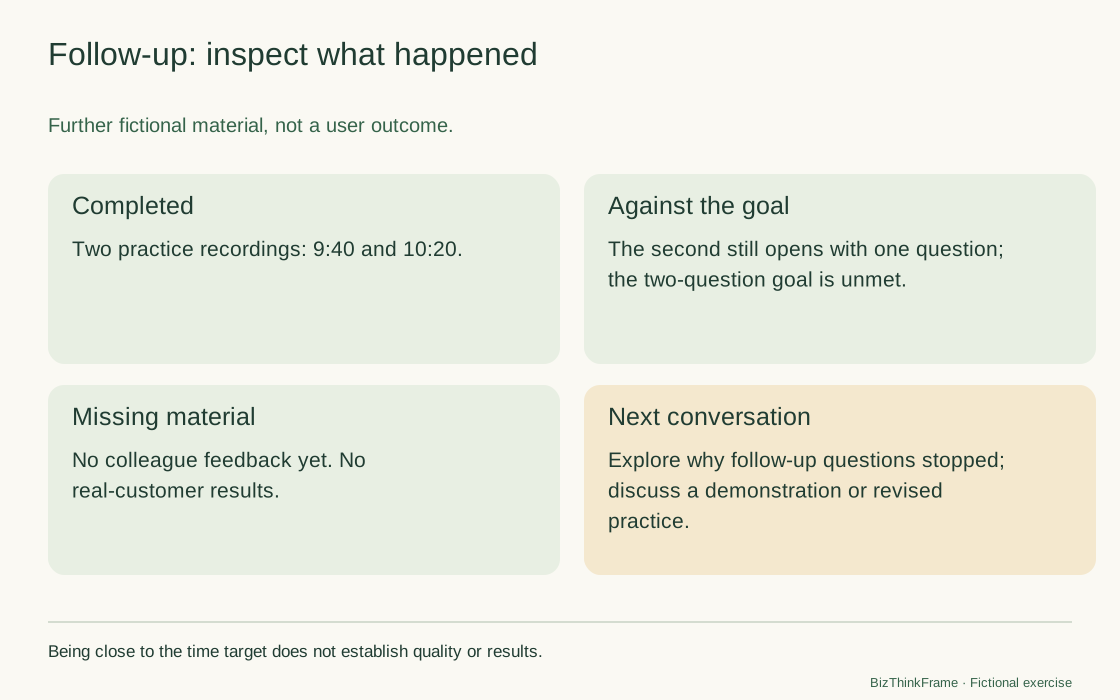
A useful question is: “Watching the second recording, what made you continue explaining features instead of asking a follow-up question?” If Lan needs to see how answers can guide a demonstration, the next step may include a specific example before further practice. Do not repeat an action merely to preserve the original plan.
The need for an example is a conditional branch to assess at review, not an established cause of Lan's earlier behavior. The practice below compares open exploration, leading questions and necessary instruction. These are our original response exercises, not an assessment of real coaching effectiveness.
What do you ask next, and who chose the action?
Compare ways to respond in the fictional dialogue, without a coaching score.
At the start of the fictional conversation, Lan wants to organize customer demonstrations more confidently within four weeks.
Choose a response to examine what it brings to the conversation.
Check choices and support in your own conversation
Select a passage, name its speaker and mark its nature, up to 30 annotations. If the speaker is unknown, state that explicitly rather than guessing. Editing the original clears annotations but retains review notes; download first to keep earlier links.
Before marking an action as chosen, check that the person chose it. Before marking support as agreed, check the provider's actual reply. The label itself does not establish agreement.
Review the complete record
Personal coaching record; speakers and classifications are supplied by you, not verified commitments or outcomes

Full original conversation:

Goal and observable signs:
Checkable observations and the person’s explanations:
Resources, requests and support status:
Options and tradeoffs:
Personal choice and confirmation status:
Action, date and time:
Review method and evidence locations:
Actual completion, unfinished work and unknowns:
Next adjustment:

Classified passages:


Next review question and matters to confirm:


Current speaker and category for the next annotation:


Person's chosen action

Complete raw annotation value:

[]

A manager's suggestion is not a personal commitment. Requested support is not agreed support. Completed practice does not establish the goal or customer outcome.
Personal material is saved separately by language in this browser. It is not uploaded or translated. Clearing site data deletes it; keep a downloaded copy and avoid editing it in multiple tabs. Review checks reset after changes.
Keep a record you can use next time
Select passages from your full conversation above, name each speaker and distinguish goals, observations, personal explanations, manager suggestions, options, chosen actions and support status. Marking support as agreed requires checking the provider's words. Lan saying she will ask a colleague does not establish the colleague's agreement. You supply the classifications; they do not verify commitments.
Copy or download the complete conversation, all annotations and the next review question. The existing English practice pack still provides dialogue material, a blank record and follow-up prompts. Unanswered questions can remain open.
Use the retrospective-to-plan case to turn a finding into the next practice. To explain the current position and request support, arrange the material manually in the work-update tool. Confirm the next action and support arrangements with the person concerned.
Practice materials
- Original fictional case and status boundariesJSON · 1 KB
- Blank outline, fictional statement and practice checksTXT · 2 KB