The cause is unclear. What should you check first?
Trace the scope of explanations through fictional late orders, retain unexplained cases, and leave with evidence status and a next investigation step.
On this page
When the cause is unclear, separate the bounded observation, available records, and possible explanations. An issue tree helps organize several investigation paths. For a specific event with a sequence of records, 5 Whys helps ask successive questions. At each step, check which records the explanation covers and which remain unexplained.
This fictional order case moves from 20 late orders to eight stock-confirmation orders, then to six with further records. Keep the other two open. Explore the evidence path beside the explanation, then paste your own analysis, select one explanation to investigate, and retain the known facts, hypotheses, unknowns, and next check.
What a classic example teaches
The Lean Enterprise Institute presents Taiichi Ohno's example of a stopped machine. The investigation follows a blown fuse through lubrication problems and pump wear to metal scraps entering a pump without a strainer. Replacing a failed part would leave the conditions behind the failure unresolved. The source also explains that five is not a mandatory number of questions. Read the example.
That teaching example presents a completed chain. Your investigation may begin with a symptom and several untested explanations. Five plausible sentences from a meeting are not equivalent to five established causal links.
Use the same evidence for both methods
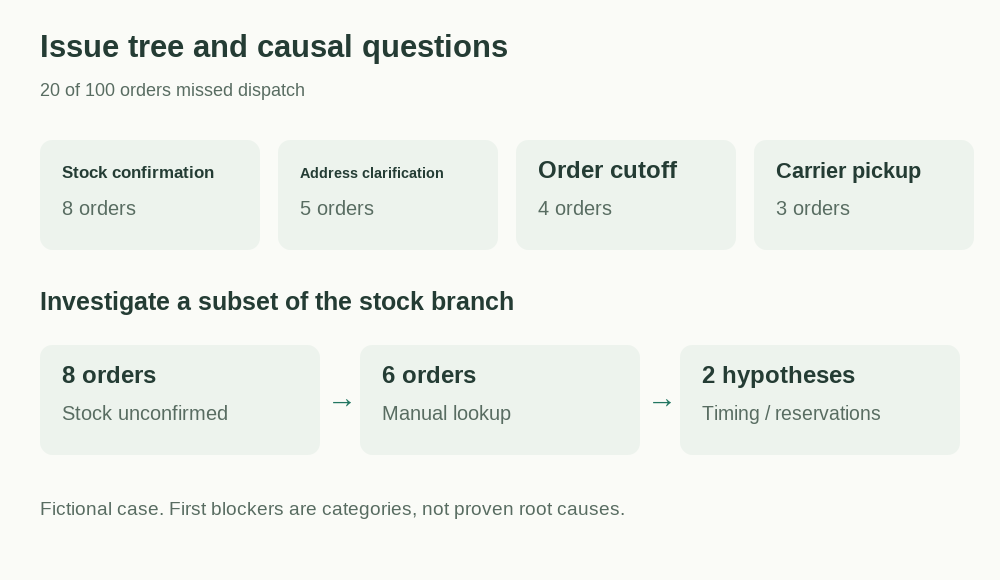
Consider this fictional practice case. A small store promised to dispatch 100 orders during a week. Twenty missed their promised dispatch date. Each late order is assigned to its first recorded blocker.
| First recorded blocker | Orders | Evidence available |
|---|---|---|
| Stock confirmation incomplete | 8 | Order logs and stock lookup records |
| Address clarification required | 5 | Address fields and customer messages |
| Different interpretations of the order cutoff | 4 | Page wording and order timestamps |
| Carrier pickup changed | 3 | Handover records and carrier notice |
This issue tree separates four investigation paths. The counts add up to twenty because the classification assigns each order once. That does not mean each order had only one real-world cause.
Stock confirmation affects the most orders, which makes it a reasonable starting point. Volume is only one consideration. A small group of highly time-sensitive orders might deserve attention first.
Keep the scope of each answer visible
Investigating the stock branch produces this record:
| Question | Current answer | Evidence status |
|---|---|---|
| Why did these eight orders miss dispatch | Stock had not been confirmed before the cutoff | Established in the practice logs |
| Why was confirmation incomplete | Six required a manual lookup in another stock record; two remain unexplained | Lookup records available |
| Why did those six require a manual lookup | Displayed stock differed from warehouse availability | Same-day records available |
| Why did the numbers differ | Update timing or stock reservations might explain it | Two hypotheses to investigate |
The second answer narrows the investigation from eight orders to six. Keep the other two on the open-questions list. Applying the six-order explanation to all eight would overstate what the evidence supports.
Now compare update timestamps, reserved stock and warehouse counts. If both hypotheses contribute, branch at that point. A 5 Whys investigation does not require every problem to have a single linear cause.
At this stage, “the system did not synchronize” is premature as a final conclusion. A more useful next step identifies which records to inspect, what result would support each explanation, and who will perform the check.
Choose a starting point from your evidence
| What you have | Useful starting point | Main risk |
|---|---|---|
| One specific incident and a sequence of records | 5 Whys | Treating a plausible link as an established cause |
| A broad outcome with several explanations | Issue tree | Overlapping branches or inconsistent levels of detail |
| A concentration of incidents in one branch | Investigate that branch with successive questions | Generalizing a subset to the whole problem |
| Opinions without records | Evidence collection plan | Making a complete diagram from incomplete evidence |
An issue tree can also organize possible solutions. Keep a tree asking why something happened separate from one asking how to change it. Switching questions halfway down a branch makes the reasoning difficult to follow.
Follow the evidence and check its scope
Explore the fictional path. Other branches and unexplained orders remain open; choosing a step does not change personal material.
20 late orders: branch out
- Observation
- First recorded blockers: stock 8, address 5, cutoff 4, pickup 3; total 20.
- Evidence
- Order and process records support this classification; each order is assigned once.
- Unknown
- A first blocker is not the only real-world cause. Volume does not establish impact or priority.
- Next check
- Inspect records, impact, and deadlines before choosing a branch; retain the other branches.
All four branches remain: 8 + 5 + 4 + 3 = 20. Further records cover six of the eight stock orders; two remain unexplained.
Review the complete record
Fictional order investigation; not a business finding

20 late orders: branch out

First recorded blockers: stock 8, address 5, cutoff 4, pickup 3; total 20.

Order and process records support this classification; each order is assigned once.

A first blocker is not the only real-world cause. Volume does not establish impact or priority.

Inspect records, impact, and deadlines before choosing a branch; retain the other branches.

Scope: 100 promised, 20 late; stock 8, address 5, cutoff 4, pickup 3. Further records cover 6 of the stock 8; 2 remain unexplained.
Prepare your own investigation
Paste your analysis as one piece. Select the explanation you want to check, then use the button below. Keep evidence, contrary observations, the next check, owner, and review date in the original material.
Selected explanation: Select an explanation in the original material; none is selected yet.
Review the complete record
Personal investigation; supplied material has not been verified by this site

Full original material:

Problem scope and period: [what happened, to whom, and record location]
Investigation branches and counting rule: [branches and unexplained records]
Current explanation: [select one explanation to investigate]
Sample scope: [which records it covers]
Supporting material and status: [records available or still needed]
Contrary observations: [what would change my explanation]
Next check: [records to inspect and how to interpret them]
Owner and review date: [actual agreement or unconfirmed]
Open questions: [retain unexplained records; a hypothesis is not a root cause]

Explanation selected for this check:

Not selected

Evidence status marked by you:

Supporting records not yet identified

Review items checked for this version (not factual verification): 0/2

Retain hypotheses, unknowns, and evidence checks. This record does not establish a root cause.
Personal material is saved separately by language in this browser. It is not uploaded or translated. Clearing site data deletes it; keep a downloaded copy and avoid editing it in multiple tabs. Review checks reset after changes.
Turn the analysis into your next investigation
Write down a bounded problem first: what happened, to whom, during which period, and how you know. Sketch the main branches and inspect one with enough evidence to justify further work. At every step, record the explanation, its evidence and the remaining uncertainty.
Use the logic tree guide when several explanations need organizing. If you already have a specific event and a sequence of records, go directly to the 5 Whys guide. You do not need to draw a tree simply to use both methods.
For each of this example's final hypotheses—update timing and stock reservations—record which evidence to inspect and what would support or contradict it. Add an owner and review date, or mark them as unconfirmed. Keep the two unexplained orders separate. The next output is a check result, rather than a combined label such as “synchronization failure.”
You can practice with the order counts and evidence record. Before extending the diagram, check that the counts reconcile, the scope stays consistent, and the final question leads to an observable check. Those checks make the analysis useful even when a root cause has not yet been established.
For AI-assisted organization, provide the problem scope, original records, current explanations, and unknowns. Ask it to flag connections lacking evidence. This exercise retains scope and investigation status; a complete causal chain or checked review item cannot replace actual evidence collection.
Separate feelings from an inspectable problem
Making a complaint specific does not require suppressing emotion. Record both your experience and the observed gap. If there is no baseline, first agree an inspectable expectation. Analyze causes after establishing the gap. Labels such as “poor attitude” or “doesn’t care” are not an adequate basis for a cause tree.
Feelings deserve attention and may signal a real work issue. Separate feelings, observations and explanations to clarify the next step. This does not dismiss personal distress or reduce organizational problems to attitude.
| Check | What to retain |
|---|---|
| Feeling and need | Describe your experience without attributing motives to others. |
| Inspectable gap | Specify the object, agreement, actual state and impact. |
| Explanation to test | Propose an evidence check without deciding the cause in advance. |
Read the dialogue, then use the one-page diagram to check the method. The Example tab uses a separate fictional scenario. Copy the prompt to organize your material, or open the original practice to continue a saved draft. Keep unknowns, evidence gaps and unapproved arrangements explicit.
The situation
Fictional scenarioFeelings deserve attention and may signal a real work issue. Separate feelings, observations and explanations to clarify the next step. This does not dismiss personal distress or reduce organizational problems to attitude.
Separate feelings from an inspectable problem
Compare the categories and the evidence each needs. Classification does not turn a hypothesis or proposal into a fact.
Separate feelings from an inspectable problem
- 01
Feeling and need
Describe your experience without attributing motives to others.
- 02
Inspectable gap
Specify the object, agreement, actual state and impact.
- 03
Explanation to test
Propose an evidence check without deciding the cause in advance.
Apply it to your own work
Copy the prompt and add your material to prepare a draft you can adapt.
View prompt
Continue with your saved material
Open the original practice to continue with material saved in this browser.
Move from description to a testable action
Numbers do not choose an action by themselves. A rate change describes a pattern without establishing its cause. Check comparability and competing explanations. Retain assumptions in forecasts and feedback checks in proposed actions. Where evidence is missing, an explicit investigation is more useful than a fabricated causal chain.
Description, diagnosis, prediction and prescription answer four different questions. Later stages are not automatically more reliable, and not every update needs a forecast. With limited evidence, the appropriate action may be investigation.
| Check | What to retain |
|---|---|
| Describe · what happened | State definitions, scope and observation. |
| Diagnose · why | Connect explanations to evidence and label unproven causes. |
| Predict · what may happen under which conditions | Retain assumptions and uncertainty; do not invent probabilities without a basis. |
| Act · what to do and how to review | Connect the proposal to evidence, action and an outcome check. |
Read the dialogue, then use the one-page diagram to check the method. The Example tab uses a separate fictional scenario. Copy the prompt to organize your material, or open the original practice to continue a saved draft. Keep unknowns, evidence gaps and unapproved arrangements explicit.
The situation
Fictional scenarioDescription, diagnosis, prediction and prescription answer four different questions. Later stages are not automatically more reliable, and not every update needs a forecast. With limited evidence, the appropriate action may be investigation.
Move from description to a testable action
Compare the categories and the evidence each needs. Classification does not turn a hypothesis or proposal into a fact.
Move from description to a testable action
- 01
Describe · what happened
State definitions, scope and observation.
- 02
Diagnose · why
Connect explanations to evidence and label unproven causes.
- 03
Predict · what may happen under which conditions
Retain assumptions and uncertainty; do not invent probabilities without a basis.
- 04
Act · what to do and how to review
Connect the proposal to evidence, action and an outcome check.
Apply it to your own work
Copy the prompt and add your material to prepare a draft you can adapt.
View prompt
Continue with your saved material
Open the original practice to continue with material saved in this browser.
Fishbone analysis: what should you check after mapping causes?
Define an observable problem before exploring possible causes. Manufacturing often uses people, machines, materials, methods, environment and measurement. Service work can use policy, people, procedures and place. Categories help avoid omissions; they do not turn collected opinions into established causal links.
Independent fictional manufacturing example: the current description is only “variable product quality”; affected batches and the observation period need clarification. Fatigue, setup variation and material differences are candidates. Specify the machine, batch and timing, then compare maintenance, incoming material, shift and inspection records. This example is separate from the guide’s other cases and adds no measured business evidence.
Consolidate duplicates and turn “bad equipment” into a checkable proposition. Prioritize evidence by risk, available records and comparison conditions; the most votes do not establish a root cause. Five Whys can probe a candidate and an issue tree can decompose a problem. Both still require evidence.
The situation
Fictional scenarioA fishbone supports exploration followed by organization. Manufacturing can use people, machines, materials, methods, environment and measurement; service work may use policy, people, procedures and place. No category scheme replaces causal investigation.
Fishbone analysis: from candidate causes to evidence
Read the four investigation stages, then see how six manufacturing cause categories lead to one problem. Select a category for an evidence check.
Fishbone analysis
Map possible causes, then investigate them with evidence.
- Collect possible causes
- Do shift patterns or experience levels correspond to the defects?
- Collect possible causes
- Are defects concentrated on a machine or after a setup change?
- Collect possible causes
- Does quality differ between material batches?
- Collect possible causes
- Do procedural differences coincide with defects?
- Collect possible causes
- Do environmental changes align with the affected batches?
- Collect possible causes
- Does the finding reflect a product change or a measurement error?
These six categories suit a manufacturing example and can be adapted. A connection is not proof of causation: clarify, consolidate and test candidates with evidence.
Apply it to your own work
Copy the prompt and add your material to prepare a draft you can adapt.
View prompt
Connect the problem to outcomes, processes and tasks
A problem-led plan defines the organizational outcome to improve, identifies relevant processes and specifies inspectable task results. Organization–process–task is not a ranking from manager to employee; one person may hold responsibilities at several levels. Two levels may fit a small problem, while four may suit more complex work.
Separate fictional example: to improve handoff reliability, propose checking pre-submission validation and post-submission acceptance, with a missing-item checklist and pending-review log. This states intended work; it does not prove those processes caused current waits. Use an issue tree to scope investigation and records, interviews or observation to test causal hypotheses. Without a baseline, do not invent an improvement magnitude.
| Check | Method and boundary |
|---|---|
| Organizational outcome | Define the overall outcome to improve and its evidence, rather than a slogan. |
| Process objectives | Identify supporting process objectives, including interfaces, accountability and dependencies. |
| Task results | Attach specific task results and acceptance checks to the process goals; completed activity is not an effect. |
The diagram shows the complete method by default. Switch to Example to compare a fictional scenario. The prompt is copied to the clipboard; your material is not sent automatically.
The situation
Fictional scenarioOrganization, process and task are levels of goals, not three job titles. Breakdown specifies the desired changes; cause investigation still needs independent evidence.
Connect the problem to outcomes, processes and tasks
Connect the overall outcome to process improvement and task results. Three levels are a reference, not a rule: two or four may fit. Confirm accountability and acceptance at each level.
Connect the problem to outcomes, processes and tasks
Organizational outcome
Define the overall outcome to improve and its evidence, rather than a slogan.
Process objectives
Identify supporting process objectives, including interfaces, accountability and dependencies.
Task results
Attach specific task results and acceptance checks to the process goals; completed activity is not an effect.
Confirm accountability and acceptance at every level. Work downward to define support and upward to check outcomes. Connections are not causal proof.
 bizthinkframe.com
Apply it to your own work
Copy the prompt and add your material to prepare a draft you can adapt.
View prompt
Connect inspection findings to evidence and follow-up
A written inspection record should answer two questions: what can be concluded now, and how could someone check that conclusion? Lead with the conclusion while retaining purpose, people, scope, method and analysis. Locate the evidence behind a missing item before assigning blame. Separate proposed remediation, agreed actions and results from a later recheck.
| Perspective | What to check |
|---|---|
| Conclusion and recommendation | Summarize findings and scope; propose remediation, ownership and rechecks, separating proposals from confirmed arrangements. |
| Purpose | Explain why the inspection is needed, what it should establish and how it helps the work. |
| People | Identify participants, relevant expertise and responsibilities, including who checked what. |
| Scope and content | List the objects, period, sample scope and areas not covered. |
| Method | State inspection timing, checklist or tools, evidence and counting method. |
| Issue analysis | Describe where issues occur and their effects; distinguish evidence, possible causes and checks still needed. |
The ten handoff records here are independent of the earlier order example. Two missing attachments establish a finding in this sample, not a 20% missing rate across other projects. Next check whether each attachment was omitted or acceptance remains pending, retaining record IDs and verification results before agreeing remediation and recheck timing. A project reflection memo can separately record background, problem, impact and response, distinguishing observed from possible impacts for later learning.
The dialogue below introduces the same issue. The method diagram retains the full structure; the Example tab uses separate fictional material. Copy the prompt to organize your own records, while verifying the evidence yourself.
The situation
Fictional scenarioAn inspection report should support a quick judgment and a traceable review. Lead with the conclusion, but keep its scope within what was actually inspected.
Connect inspection findings to evidence and follow-up
Lead with the conclusion and recommendation, show four inspection foundations, then connect analysis to follow-up. All six parts remain visible; sample findings do not establish a population-wide conclusion.
Connect inspection findings to evidence and follow-up
Conclusion and recommendation
Summarize findings and scope; propose remediation, ownership and rechecks, separating proposals from confirmed arrangements.
Purpose
Explain why the inspection is needed, what it should establish and how it helps the work.
People
Identify participants, relevant expertise and responsibilities, including who checked what.
Scope and content
List the objects, period, sample scope and areas not covered.
Method
State inspection timing, checklist or tools, evidence and counting method.
Issue analysis
Describe where issues occur and their effects; distinguish evidence, possible causes and checks still needed.
Retain sample scope. Possible causes do not establish blame; proposing remediation does not complete it.
bizthinkframe.comApply it to your own work
Copy the prompt and add your material to prepare a draft you can adapt.
View prompt
Close the loop from analysis to action
An issue tree identifies branches to investigate, but a review must go beyond naming possible causes. Explain the evidenced gap, proposed response, action actually taken and evaluation still needed. Data make judgments inspectable; they do not remove the reader’s right to question them.
| Consideration | What to retain |
|---|---|
| Find the problem | Compare target and actual results using consistent scope, periods and definitions; separate the gap from possible causes. |
| Form a proposal | Propose measures grounded in evidence, stating conditions, resources and approvals still needed. |
| Take action | Execute the agreed plan and record owners, timing and deviations; an unapproved proposal is not completed action. |
| Evaluate and revise | Recheck consistent measures, other changes and evidence gaps before retaining or revising the approach. |
In a separate fictional support case, 6 of 20 sampled records are late: 30% within that sample. This is not the late-response rate for all work, nor proof that peak staffing caused it. Review the records, then seek approval for a limited routing pilot. Afterward, compare consistent measures and check workload, samples and staffing changes. If results improve, first report the observed change; attributing it to the intervention requires stronger evidence.
The dialogue and one-page diagram separate the method from a fictional example. View and copy the prompt to organize your own material, then check evidence, missing information and approval status.
The situation
Fictional scenarioData help the reader inspect a judgment; they do not authorize action. Check definitions and possible causes before proposing a feasible response, then evaluate subsequent changes.
Connect evidence to action
Use a problem–proposal–action–evaluation loop. Each review can revise the initial judgment; sequence alone does not prove an effect.
Connect evidence to action
01 → 02 → 03 → 04 → revisit the problem
Find the problem
Compare target and actual results using consistent scope, periods and definitions; separate the gap from possible causes.
Form a proposal
Propose measures grounded in evidence, stating conditions, resources and approvals still needed.
Take action
Execute the agreed plan and record owners, timing and deviations; an unapproved proposal is not completed action.
Evaluate and revise
Recheck consistent measures, other changes and evidence gaps before retaining or revising the approach.
bizthinkframe.comApply it to your own work
Copy the prompt and add your material to prepare a draft you can adapt.
View prompt
Answer three questions before collecting data
When evidence is inaccessible or incomplete, define the decision the analysis should support. Why establishes the question’s boundary, what identifies priority evidence, and how specifies the method and review frequency. These questions reduce irrelevant reporting work and make evidence requests more specific.
| Consideration | What to retain |
|---|---|
| Why analyze? | State the problem, judgment to support and intended action, rather than displaying numbers for their own sake. |
| What to analyze? | Prioritize relevant objects, measures and records; identify gaps and access boundaries. |
| How to analyze? | Choose comparison, classification or another suitable method and specify review frequency and verification. |
Separate fictional case: a team wants to decide whether to change order handoffs. The priority evidence is agreed and actual handoff times for the same orders, not every department’s totals. Without authorized access to customer timestamps, inspect internal stages and retain the external gap. Do not fill in times or extend internal observations to the whole chain. A weekly review with consistent definitions serves this question better than undirected daily reports.
The dialogue and one-page diagram separate the method from a fictional example. View and copy the prompt to organize your own material, then check evidence, missing information and approval status.
The situation
Fictional scenarioAnalytical thinking starts before a pile of reports. The objective determines priority evidence, and the question and evidence determine the method. Missing critical evidence limits the conclusion.
Ask three questions before analyzing
Move from purpose to scope, then method and frequency. Each question justifies the next step; complex tools do not replace a clear question.
Ask three questions before analyzing
Why analyze?
State the problem, judgment to support and intended action, rather than displaying numbers for their own sake.
What to analyze?
Prioritize relevant objects, measures and records; identify gaps and access boundaries.
How to analyze?
Choose comparison, classification or another suitable method and specify review frequency and verification.
bizthinkframe.comApply it to your own work
Copy the prompt and add your material to prepare a draft you can adapt.
View prompt
Practice materials
- Order counts and evidence recordJSON · 1 KB