
5 Whys vs issue trees for investigating a problem
Compare 5 Whys and issue trees using the same late-order evidence, then plan your next investigation.
On this page
Use 5 Whys to investigate a specific event through successive causal questions. Use an issue tree to organize a broader problem with several possible explanations. You can start with a tree, choose a branch worth investigating, and then ask why within that branch.
Neither structure establishes a cause by itself. The useful output is an explanation tied to evidence, with the remaining uncertainties visible.
What a classic example teaches
The Lean Enterprise Institute presents Taiichi Ohno's example of a stopped machine. The investigation follows a blown fuse through lubrication problems and pump wear to metal scraps entering a pump without a strainer. Replacing a failed part would leave the conditions behind the failure unresolved. The source also explains that five is not a mandatory number of questions. Read the example.
That teaching example presents a completed chain. Your investigation may begin with a symptom and several untested explanations. Five plausible sentences from a meeting are not equivalent to five established causal links.
Use the same evidence for both methods
Consider this fictional practice case. A small store promised to dispatch 100 orders during a week. Twenty missed their promised dispatch date. Each late order is assigned to its first recorded blocker.
| First recorded blocker | Orders | Evidence available |
|---|---|---|
| Stock confirmation incomplete | 8 | Order logs and stock lookup records |
| Address clarification required | 5 | Address fields and customer messages |
| Different interpretations of the order cutoff | 4 | Page wording and order timestamps |
| Carrier pickup changed | 3 | Handover records and carrier notice |
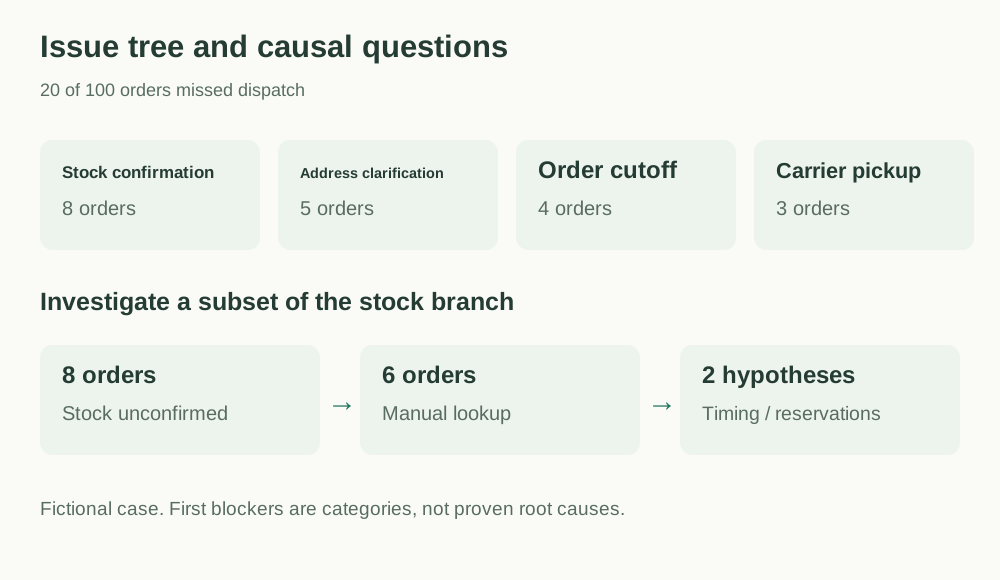
This issue tree separates four investigation paths. The counts add up to twenty because the classification assigns each order once. That does not mean each order had only one real-world cause.
Stock confirmation affects the most orders, which makes it a reasonable starting point. Volume is only one consideration. A small group of highly time-sensitive orders might deserve attention first.
Keep the scope of each answer visible
Investigating the stock branch produces this record:
| Question | Current answer | Evidence status |
|---|---|---|
| Why did these eight orders miss dispatch | Stock had not been confirmed before the cutoff | Established in the practice logs |
| Why was confirmation incomplete | Six required a manual lookup in another stock record; two remain unexplained | Lookup records available |
| Why did those six require a manual lookup | Displayed stock differed from warehouse availability | Same-day records available |
| Why did the numbers differ | Update timing or stock reservations might explain it | Two hypotheses to investigate |
The second answer narrows the investigation from eight orders to six. Keep the other two on the open-questions list. Applying the six-order explanation to all eight would overstate what the evidence supports.
Now compare update timestamps, reserved stock and warehouse counts. If both hypotheses contribute, branch at that point. A 5 Whys investigation does not require every problem to have a single linear cause.
At this stage, “the system did not synchronize” is premature as a final conclusion. A more useful next step identifies which records to inspect, what result would support each explanation, and who will perform the check.
Choose a starting point from your evidence
| What you have | Useful starting point | Main risk |
|---|---|---|
| One specific incident and a sequence of records | 5 Whys | Treating a plausible link as an established cause |
| A broad outcome with several explanations | Issue tree | Overlapping branches or inconsistent levels of detail |
| A concentration of incidents in one branch | Investigate that branch with successive questions | Generalizing a subset to the whole problem |
| Opinions without records | Evidence collection plan | Making a complete diagram from incomplete evidence |
An issue tree can also organize possible solutions. Keep a tree asking why something happened separate from one asking how to change it. Switching questions halfway down a branch makes the reasoning difficult to follow.
Turn the analysis into your next investigation
Write down a bounded problem first: what happened, to whom, during which period, and how you know. Sketch the main branches and inspect one with enough evidence to justify further work. At every step, record the explanation, its evidence and the remaining uncertainty.
The logic tree guide and 5 Whys guide offer further method explanations and are currently available in Chinese.
You can practice with the order counts and evidence record. Before extending the diagram, check that the counts reconcile, the scope stays consistent, and the final question leads to an observable check. Those checks make the analysis useful even when a root cause has not yet been established.
Start with a useful outline
Practice materials
- Order counts and evidence recordJSON · 1 KB
Related methods
Method pages currently open in Chinese.