
Disagree with your manager by making the decision easier to check
Distinguish facts, priorities and evidence gaps, compare questions to check, and retain full discussion material, actual replies, authority and open issues.
On this page
Identify whether the disagreement concerns facts, an explanation or prediction, or different priorities. Put the relevant material on the table, ask a question that can be checked, and state what would change your own view. The aim is an explainable next step; no script guarantees agreement.
This fictional supplier comparison shows how to correct a number, discuss priorities, retain unknowns, and record what remains undecided. Compare the questions for three kinds of statement, then paste your full material into the inline review and choose one issue to discuss. Take away a discussion opening and a record of actual replies, authority and open questions.
Why the same material can support different preferences
Original fictional teaching material: the cap is CNY 20,000. Prices are A 12,000, B 18,000, and C 26,000. Simulated quality/speed/cost ratings are A: 3/5/5, B: 5/3/3, and C: 5/5/1, with higher scores better. C exceeds the cap and is excluded. There are no actual trial records and no selected supplier.
At 40% quality and 30% each for speed and cost, A scores 4.2 and B 3.8. At 60% quality and 20% each for the others, A scores 3.8 and B 4.2. At 50% quality and 25% each for the others, both score 4.0. These calculations hold simulated ratings fixed; they are not measured quality.
| Statement | Type of disagreement | Question to check |
|---|---|---|
| “B exceeds the CNY 20,000 budget” | Conflicts with the fictional price | Are we using the same version? B is CNY 18,000 here; are there additional costs? |
| “Quality matters more, so choose B” | Priority and judgment | Which requirements are mandatory? What speed or cost tradeoff is acceptable? |
| “A scores higher, so it cannot go wrong” | Evidence gap between rating and claim | Which comparable trials support the rating? What failed or remains unknown? |
In real work, taxes, maintenance, or revised quotes may change the comparison. Align definitions and versions before correcting someone. A number from this exercise cannot establish that a real colleague is wrong.
An opening that makes room for checking
We both need an option that meets the quality requirements within budget. Could we first check the comparison? B is CNY 18,000 in this version, within the CNY 20,000 cap. If there is a revised quote or additional cost, let's update it together.
My earlier preference for A used the simulated calculation with quality at 40%, alongside speed and cost. At 60% quality, B leads; at 50%, they tie. Priorities change the ranking, and scores do not establish actual quality.
Could we confirm mandatory requirements and arrange comparable trials? I would change my recommendation if evidence showed that A fails a mandatory condition, or if we establish a higher priority for quality. Ownership, trial effort, dates, and approval need confirmation. This discussion has not selected a supplier.
The opening makes your assumptions visible and leaves room for new information. It does not infer motives, treat ratings as objective facts that settle priorities, or turn agreement to check evidence into purchase approval.
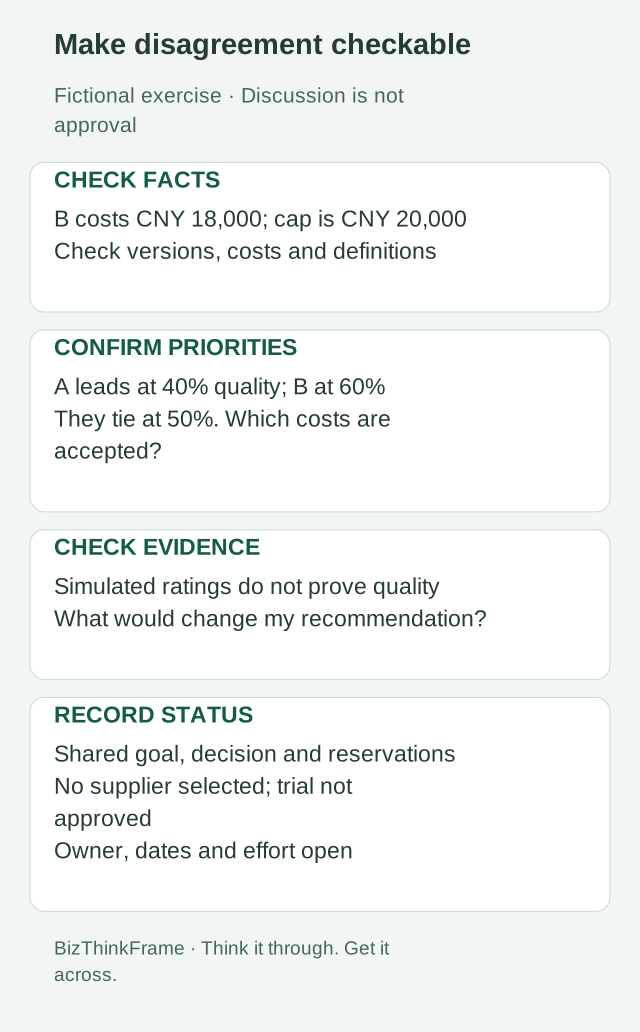
Ground the disagreement in material
Prepare three questions: what supports my recommendation, what might I be missing, and what would change my view? If preferences differ, discuss goals and accepted costs. If a number is wrong, check its version, definition, and source. Data also has scope, missingness, and interpretation limits; producing a number does not settle every dispute.
A statement can mix several disagreements. “B costs more, so it is not worth it” involves both a complete price comparison and a judgment about value. Start with the smaller part you can check rather than forcing one label. Conditions for changing a view apply to your recommendation too, not just the other person's.
Choose a format that lets people examine the material. Routine discussions can use an agreed time and channel. A material factual error requiring timely action should not wait indefinitely for an ideal setting. This is an exercise in discussing work judgments; actual authority and reporting channels follow the organization's agreements.
Record the discussion's actual result
| Item | State supported by this example |
|---|---|
| Shared goal | Meet quality requirements within budget; mandatory conditions open |
| Material checked | Fictional prices and simulated calculations; real quotes, costs, and trials still needed |
| Disagreement | Priorities and acceptable speed/cost tradeoffs not yet agreed |
| Proposal | Confirm requirements and run comparable trials; not approved |
| Decision and next step | No selected supplier; owner, dates, and effort open |
Update the record with what was actually confirmed. Disagreement, no response, agreement to gather evidence, trial approval, and purchase approval are distinct states. If an authorized owner makes a decision, record accepted tradeoffs, remaining risks, and review conditions. Do not replace genuine reservations with “everyone agreed.”
If the reply only agrees to obtain a trial quote, record that scope. Trial and purchase authorization remain open; do not invent an agreed trial owner or completion date. The reply selector below refers only to your selected issue. Keep other matters in the discussion notes.
Choose the question to check, then record the actual reply
Explore three disagreements in the fictional supplier material. Example choices do not enter your personal draft.
- Disputed statement
- B exceeds the CNY 20,000 budget.
- What to address first
- Facts and definitions
- A question to check
- Are we using the same quote version? B is CNY 18,000 here. Are taxes or maintenance additional?
- What would change my view
- I would revise the budget assessment if the complete, comparable quote exceeds CNY 20,000.
- Limit
- Check version, scope and costs first. Exercise numbers cannot prove a real colleague wrong.
Try one disagreement of your own
Keep both speakers' words and context, then select one disputed passage. Editing the original or selecting another passage resets its classification and reply; preparation and discussion notes remain for review. Download first to retain the earlier link.
No disputed passage selected.
Select the disputed passage, then identify a question to check.
After the discussion, record the actual reply
The selection records your assessment. Trial and purchase approvals are separate decisions; a reply on one does not cover another.
Review the complete record
Personal disagreement record; classifications and replies are your record, not fact verification or approval

Full original:

Shared goal and decision needed:
My recommendation, evidence and possible omissions:
What the other person actually said (no inferred motives):
Facts, interpretation or priorities in dispute:
Versions, definitions, evidence locations and unknowns:
Checkable question or comparison action:
Evidence that would change my view:
Accepted tradeoffs:
Actual confirmed decision, authority and reservations:
Owner, date and time, effort and approval:
Follow-up:

Selected disputed passage:

Not selected or unreadable

Your classification:

Unclear or mixed

Preparation:


Current reply on this issue:

Unconfirmed or no reply

Discussion record (scope, authority, supporting record and open issues):


Raw selection value:


No reply is not agreement. Agreement to check is not trial or purchase approval.
Personal material is saved separately by language in this browser. It is not uploaded or translated. Clearing site data deletes it; keep a downloaded copy and avoid editing it in multiple tabs. Review checks reset after changes.
Practice with a real disagreement
Paste your complete material into the exercise above, keeping both speakers' words. Select one issue and write a question to check and what would change your view. After discussion, record only what was actually confirmed, retaining gaps. Classifications and replies are your assessment, not facts or approvals verified by this site. Copy or download the complete original, selected passage, preparation and discussion notes, or use the existing downloadable outline.
Request checks when evidence is missing; state a recommendation and its costs when evidence is sufficient. For recalculation, use the decision matrix sensitivity example. For a concise request before discussion, prepare a one-page decision brief. With a completed record, the option comparison tool lets you confirm a preview and create a new decision-request draft. It does not set priorities or establish consensus for you.
Practice materials
- Blank outline, fictional statement and practice checksTXT · 2 KB
- Fictional supplier comparison, weight scenarios and unknownsJSON · 2 KB